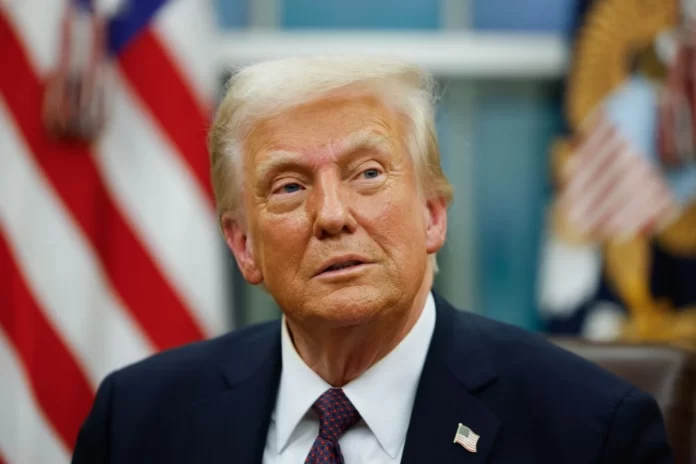
Washington : US President Donald Trump said on Friday that the United States has agreed to resume talks with Iran after Tehran requested another round of negotiations, while stressing that the ceasefire reached between the two sides last month is no longer in effect.
In a post on his Truth Social platform, Trump claimed Iran had approached Washington to continue diplomatic discussions. He added that the US accepted the proposal but made it clear to Iranian officials that the ceasefire had officially ended.
Trump’s comments came after fresh military exchanges between the two adversaries. Iranian forces launched strikes on US military installations in Gulf countries on Thursday in response to American attacks on Iran’s southern coastal and eastern regions.
Although both countries had agreed to a temporary truce last month that ended four months of fighting, the conflict had already disrupted global energy markets and affected oil supplies.
The renewed tensions have also intensified political pressure on Trump ahead of this year’s US midterm elections. His critics argue that he has failed to secure a lasting end to the conflict, while rising fuel prices and growing public dissatisfaction have added to the challenges facing his administration.
Amid the escalation, Qatar urged both Washington and Tehran to honour their memorandum of understanding and continue diplomatic engagement to prevent another round of conflict. According to Al Jazeera, Qatari Prime Minister and Foreign Minister Sheikh Mohammed bin Abdulrahman bin Jassim Al Thani conveyed the message during a telephone conversation with Egyptian Foreign Minister Badr Abdelatty.
The Qatari premier also highlighted the importance of safeguarding navigation through the Strait of Hormuz, warning that uninterrupted maritime traffic is essential for regional security and global trade.
Meanwhile, Iran maintained its tough stance. A senior commander of the Islamic Revolutionary Guard Corps (IRGC) vowed retaliation against the United States and Israel over the killing of Supreme Leader Ayatollah Ali Khamenei, saying the incident would never be forgotten.
According to Al Jazeera, Brigadier-General Ahmad Vahidi called for justice and promised a strong response against those responsible, particularly the United States.
His remarks came shortly after Ayatollah Khamenei was laid to rest in his hometown of Mashhad, four months after he and four members of his family were killed in US-Israeli air strikes.
Separately, Iran’s Supreme National Security Council warned that any attacks on the country’s infrastructure would be met with retaliation, adding that Israel would also face consequences.
Despite the sharp rhetoric, diplomatic contacts continue behind the scenes. CNN, citing US officials, reported that Washington is pursuing a strategy of combining limited military operations with negotiations in an effort to reduce tensions.
One US official said military strikes have been deliberately limited before pausing operations to create space for diplomacy. Officials added that the United States continues to maintain a list of potential military targets as leverage during negotiations, while remaining prepared for further military action if required.
Meanwhile, the UK Maritime Trade Operations (UKMTO) warned that security risks in the Strait of Hormuz remain severe following recent attacks on commercial shipping.
In an advisory issued through its Joint Maritime Information Center, the UKMTO confirmed that the expanded southern shipping route remains open but urged vessels to remain vigilant, monitor naval communications and exercise caution near designated mine-risk areas.
Egypt and Qatar also reaffirmed their commitment to preventing further escalation. During a phone call, Egyptian Foreign Minister Badr Abdelatty and his Qatari counterpart stressed the importance of diplomacy and urged all parties to implement the existing US-Iran memorandum of understanding as a pathway towards a broader agreement capable of easing regional tensions.
Abdelatty also condemned the recent attacks targeting several Gulf countries and Jordan, while reaffirming support for their sovereignty, territorial integrity and regional security.
Separately, the International Energy Agency (IEA) reported that global oil supplies recorded their largest monthly increase in June after shipping traffic through the Strait of Hormuz recovered. However, the agency noted that production remains below pre-conflict levels as ongoing security concerns continue to affect energy output across the region.