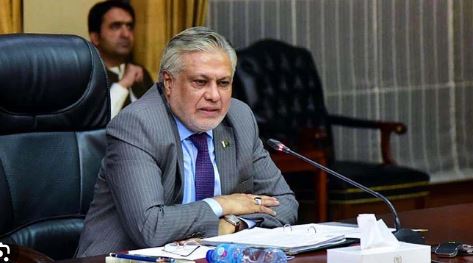
Istanbul: Deputy Prime Minister and Foreign Minister Ishaq Dar said Pakistan and Türkiye are ready to shape a common future centred on prosperity, innovation and regional stability, while calling for stronger economic collaboration between the two countries.
Speaking at the Pakistan–Türkiye B2B Conference in Istanbul, Dar said Islamabad and Ankara have always stood by each other on matters relating to regional peace, security, humanitarian assistance and issues of vital national importance.
He said the strong political relationship enjoyed by the two countries should now be translated into a dynamic economic partnership that delivers mutual benefits.
Referring to the changing global economy, Dar noted that geopolitical rivalries, technological progress, evolving supply chains, the global energy transition and changing trade patterns are reshaping international markets.
He said Pakistan and Türkiye, owing to their strategic locations connecting Europe, Asia, the Middle East and Central Asia, are ideally positioned to strengthen regional connectivity and create new economic opportunities.
The deputy prime minister urged both countries to make full use of their geographical advantage by expanding trade, attracting investment and enhancing industrial cooperation.
He observed that modern diplomacy now extends beyond political engagement and plays a crucial role in driving economic development and prosperity.
Dar also called upon Pakistan’s diplomatic missions, trade offices, investment agencies and business organisations to work in close coordination to promote exports, attract foreign investment and address challenges faced by businesses.
Highlighting Pakistan’s economic progress, he said the government has introduced comprehensive reforms aimed at improving macroeconomic stability, rebuilding investor confidence and fostering a business-friendly climate.
He invited Turkish investors to explore opportunities in Pakistan’s energy, mining and minerals, power infrastructure, information technology, manufacturing, agriculture, logistics, tourism and defence sectors, saying these industries offer strong prospects for investment, technology transfer, industrial growth and job creation.
Addressing the conference, Energy Minister Sardar Awais Ahmad Khan Leghari said Pakistan has carried out major reforms in the power sector, cutting electricity distribution inefficiencies by more than 45 percent over the last two years.
He said electricity distribution companies have been restructured and prepared for privatisation under reforms designed to improve efficiency, transparency and service delivery.
Leghari added that new legislation has also been enacted to prevent the government from establishing or acquiring additional power generation companies in the future.
He said Pakistan has introduced a competitive electricity market and established an Independent System and Market Operator to ensure efficient and transparent power dispatch, while the National Grid Company has been split into two entities to enhance operational performance.
The minister said the government is modernising and digitising electricity metering systems to reduce transmission losses, curb power theft and improve transparency.
He noted that the power sector offers investment opportunities exceeding $1.7 billion over the next two to three years, while the transmission sector presents additional opportunities worth around $830 million over the next four years.
Leghari said two major infrastructure projects valued at $518 million and $312 million are also under development and are expected to be completed by 2030. He added that feasibility and environmental assessments are in progress, with bankable studies expected next month to facilitate investor participation.
He also highlighted growing opportunities in battery energy storage systems, describing them as essential for ensuring grid stability and supporting Pakistan’s transition to a modern and sustainable energy system.
Meanwhile, Minister for Information Technology and Telecommunication Shaza Fatima Khawaja said Pakistan’s IT exports have recorded annual growth of more than 20 percent over the past three years, reaching $4.5 billion.
She said Pakistani freelancers contributed $1.1 billion to export earnings this year, while over 26,000 IT companies and 75,000 technology graduates are driving the country’s rapidly expanding digital economy.
Shaza Fatima noted that Pakistan is the world’s fourth-largest outsourcing destination and has a youthful population of more than 150 million people under the age of 35.
She added that the country has over 200 million telecom subscribers, including 157 million mobile internet users, with 97 percent of the population covered by 3G and 4G services. She also said 5G services have already been introduced in 11 cities and highlighted investment opportunities in cybersecurity, semiconductors, satellite technology and data centres.