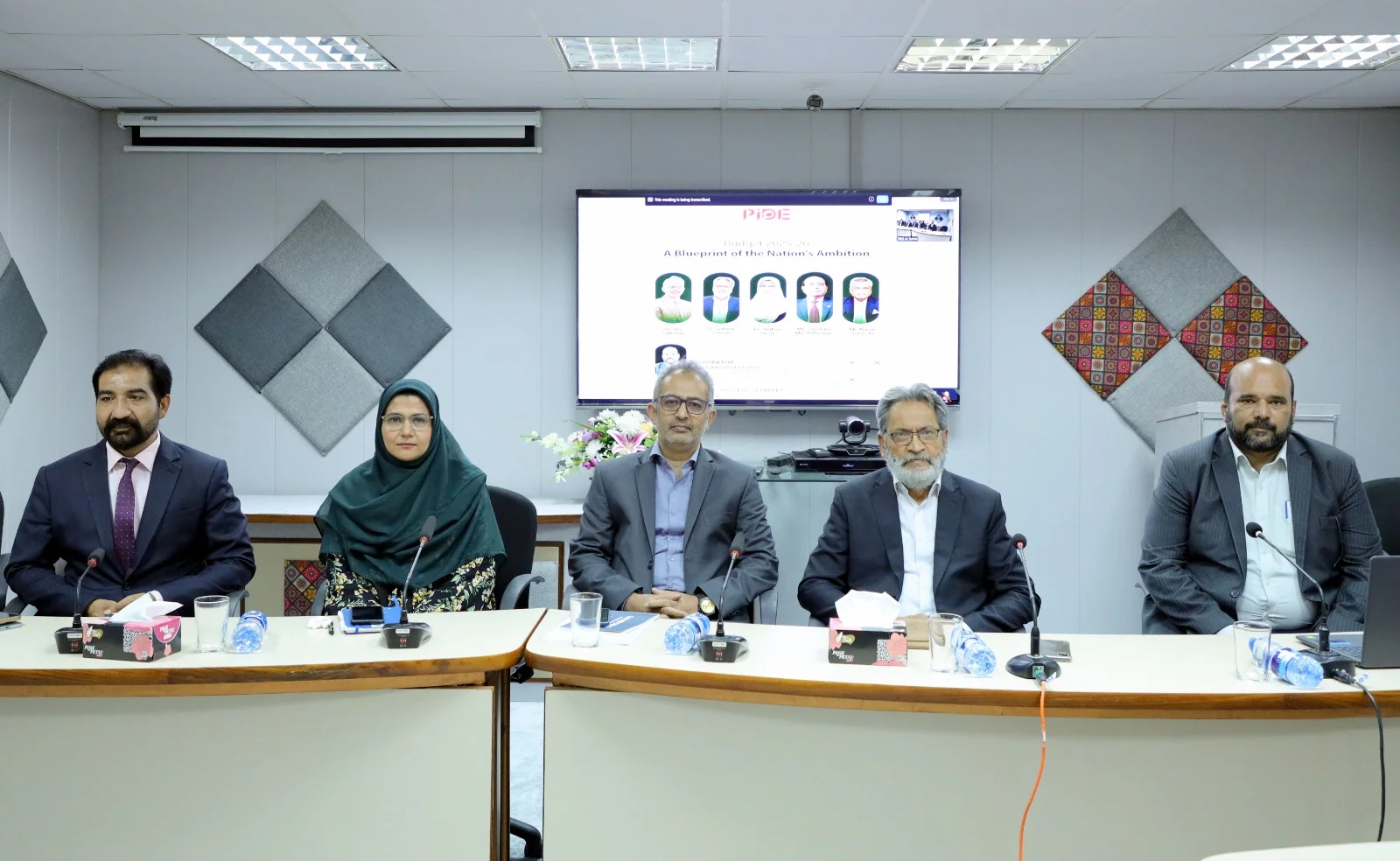
ISLAMABAD: The Pakistan Institute of Development Economics (PIDE) held a national seminar titled “Budget 2025–26: A Blueprint of the Nation’s
Ambition” to examine the federal budget’s strengths and gaps.
Economists, policy experts, and business leaders came together to assess whether the proposed budget truly reflects Pakistan’s development vision and priorities.
PIDE’s Dr. Mahmood Khalid praised the government’s success in creating macroeconomic stability but warned that fiscal transparency and strategic vision must follow.
He said that without long-term coherence and credibility, stability will not lead to real development.
Revenue and Reform: A Shift in Focus Needed
Dr. Ali Salman from the PRIME Institute acknowledged the realistic revenue goals but cautioned that raising taxes without broadening the tax base disproportionately hurts low- and middle-income groups.
He recommended tax reforms targeting under-taxed sectors, empowering provinces through decentralization, and linking budget allocations with performance.
He emphasized that a predictable, fair tax system would not only enhance compliance but also promote business expansion and job creation.
Green Growth, Tech Integration, and Governance
Dr. Safdar Sohail stressed the need to modernize Pakistan’s economy by focusing on green and digital transitions.
He advocated policies that use technology, artificial intelligence, and circular economy models to improve productivity.
He also called for the budget to be a tool for reform in climate, competition, and service delivery.
Other experts including Dr. Hafsa Hina (PIDE) highlighted the constraints of IMF conditions.
She warned about rising inflation due to global trends and tax reforms but remained optimistic if policies are well-aligned.
Business Voices Demand Consistency
Industry representatives like Mr. Qazi (ICMA) and Mr. Ramzan (Islamabad Chamber) called for stable and business-friendly policies.
They criticized abrupt steps like e-invoicing without groundwork and high tax rates, which increase operational costs.
Speakers emphasized the need to foster a competitive market environment, reduce regulatory uncertainty, and improve investment conditions.
The seminar concluded with clear recommendations: use frameworks like URAAN Pakistan, strengthen fiscal federalism, digitize tax systems, and involve civil society for better budget monitoring and transparency.