Washington (Web Desk/Agencies): US President Donald Trump on Wednesday ramped up pressure on Iran over a potential nuclear deal, urging Tehran to speed up its decision-making and warning against further delays.
In a post on his Truth Social platform, Trump said Iran was struggling to finalize a non-nuclear agreement. “Iran can’t get their act together. They don’t know how to sign a nonnuclear deal. They better get smart soon,” he wrote, adding, “No more Mr. nice guy!”
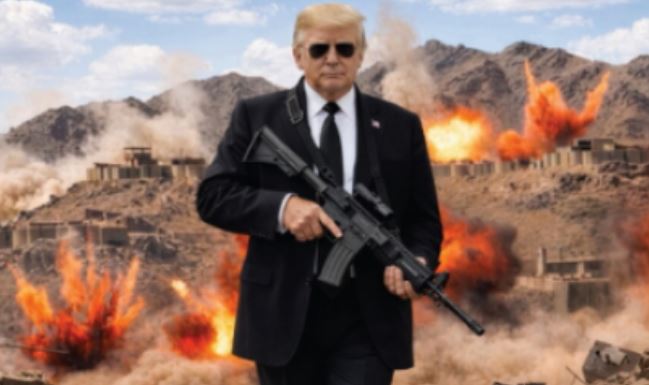
The post also included an AI-generated image depicting Trump in a black suit and sunglasses holding a firearm, with explosions shown in the background across an Iranian landscape, underscoring the combative tone of his message.
Earlier developments in the region saw heightened tensions following a joint US-Israel military offensive against Iran on February 28, which led Tehran to respond with strikes targeting American-linked interests in parts of the Gulf region.
A ceasefire was later brokered on April 8 through mediation efforts involving Pakistan, followed by negotiations held in Islamabad on April 11 and 12. However, the talks ended without any concrete agreement. Trump later claimed the truce had been extended at Pakistan’s request, pending a fresh proposal from Tehran.
By Monday, the US president expressed doubt over Iran’s latest diplomatic approach, which reportedly suggested reopening the Strait of Hormuz while postponing detailed nuclear discussions.
According to US officials cited by The Wall Street Journal, Trump instructed his team to consider extended restrictions on Iranian ports as part of a broader pressure campaign. Washington is also reportedly evaluating sustained economic and oil export pressure, as military escalation or disengagement are seen as higher-risk options.
Iran continues to insist on its right to enrich uranium for peaceful purposes, while reports suggest it currently holds significant quantities of uranium enriched to near weapons-grade levels.
Tehran has also claimed it could withstand any blockade scenario by relying on alternative trade routes and has maintained that the conflict remains unresolved.
Its latest diplomatic proposal reportedly calls for nuclear negotiations to begin only after a formal end to hostilities and resolution of maritime disputes, a stance rejected by Washington, which insists nuclear talks must come first.
At a UN Security Council briefing on April 28, Iranian envoy Saeed Iravani accused Israel of ongoing violations in Gaza and the West Bank, calling for stronger international action and accountability for alleged war crimes.
Meanwhile, reports indicate internal changes in Iran’s decision-making structure, with increasing influence from security institutions, particularly the Islamic Revolutionary Guard Corps (IRGC), amid a shift away from traditional clerical authority.
Analysts say Iran’s decision-making process has become slower and more fragmented, with multiple power centers shaping policy, particularly in negotiations led by Foreign Minister Abbas Araghchi and senior security figures.
A Pakistani official involved in mediation efforts reportedly described Iran’s response system as delayed and decentralized, suggesting that no single authority is driving quick decisions.
Experts argue that the core deadlock stems not from internal divisions within Iran but from the widening gap between US demands and Iran’s acceptable negotiation terms.
Former US diplomat Alan Eyre summed up the situation by saying neither side appears willing to compromise, with both believing time is working in their favor.
Despite ongoing pressure and diplomatic activity, analysts say there are no clear signs of internal breakdown in Iran, with its leadership increasingly focused on a security-driven strategy aimed at deterrence, regional influence, and economic resilience.