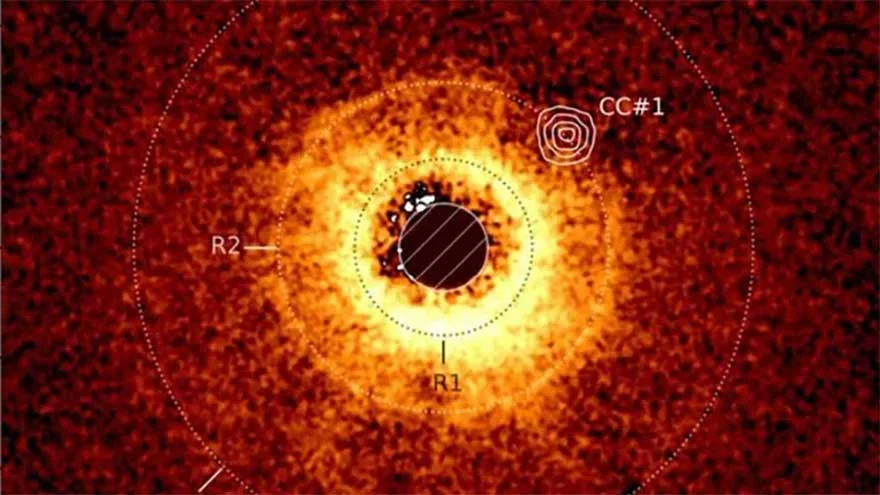
ISLAMABAD: In a major astronomical breakthrough, NASA’s James Webb Space Telescope (JWST) has directly discovered its first new planet beyond our solar system—an exoplanet named TWA 7b.
This marks a significant milestone for the $10 billion telescope, known for its infrared sensitivity and deep-space capabilities.
The planet, located about 111 light-years away in the constellation of Antlia, is orbiting a young, low-mass star known as CE Antilae or TWA 7.
Unlike most previously known exoplanets found using indirect methods, TWA 7b was captured through direct imaging, making it the lowest-mass exoplanet ever observed in this way.
Revealing the Secrets of a Young Planetary System
TWA 7b is estimated to be about 100 times the mass of Earth, or roughly one-third the mass of Jupiter.
The planet resides in a debris disk surrounding CE Antilae, a star just a few million years old.
This star is observed pole-on from Earth, providing astronomers a clear top-down view of its disk and allowing them to analyze its unique ring structures.
The JWST detected an infrared source within one of the disk’s narrow rings—an observation confirmed by simulations, which revealed a planet-shaped void in the disk consistent with TWA 7b’s presence.
The ring’s structure and gravitational gaps helped scientists pinpoint the planet’s exact location.
JWST’s Power in Exoplanet Discovery
The JWST’s Mid-Infrared Instrument (MIRI), along with a built-in coronagraph to block out stellar light, proved essential in capturing the faint infrared glow of TWA 7b.
This success demonstrates the telescope’s unmatched ability to detect young, low-mass planets previously hidden in stellar glare.
Astronomers say the discovery of TWA 7b is likely just the beginning.
With its exceptional infrared vision, the JWST is expected to uncover more such worlds in the coming years—bringing us closer to understanding planet formation and the diversity of planetary systems.