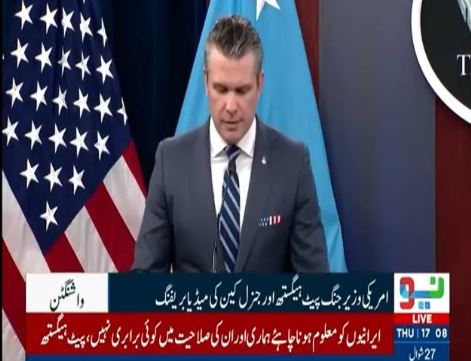
Washington: The United States has delivered a strong warning to Iran, saying that any disruption in the Strait of Hormuz would trigger a decisive military response. The statement was made by US Defense Secretary Pete Hegseth and Chairman of the Joint Chiefs of Staff General Dan Kane during a press briefing at the Pentagon.
Officials said US forces are closely tracking Iranian military movements and remain fully prepared to respond if the situation escalates. While diplomatic negotiations with Tehran are ongoing, they warned that a failure to reach an agreement could open the door to renewed large-scale military operations.
Defense Secretary Hegseth stressed that Iran must not be allowed to develop nuclear weapons under any circumstances, describing it as a firm and non-negotiable position. He further cautioned that interference with global shipping routes in the Strait of Hormuz would be treated as hostile and unlawful activity.
He also claimed that Iran’s naval capability has significantly weakened and warned that any attempt to block the strategic waterway would result in severe consequences, including the targeting of remaining military assets.
General Dan Kane added that a potential maritime blockade could extend beyond international waters into Iranian territorial zones. He said vessels entering or leaving Iranian ports could be stopped regardless of origin, and any support for Iran in this context would also face interception.
US officials expressed hope for a negotiated settlement but maintained that pressure measures and naval control in the region would continue if no agreement is reached.