Changsha, China : Pakistan and China on Monday signed three separate memorandums of understanding (MoUs) aimed at expanding cooperation in important areas such as desalination, agricultural innovation, and the tea industry.
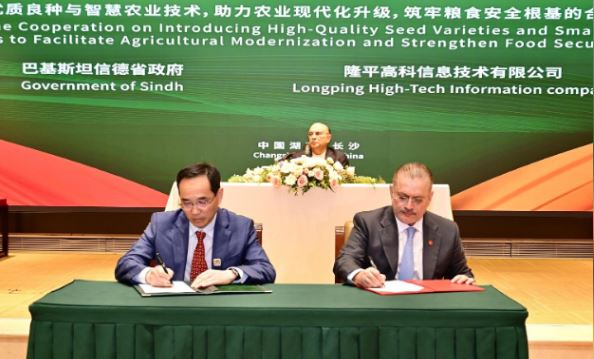
The agreements were witnessed by President Asif Ali Zardari during his five-day official visit to China, where he observed the formal exchange between relevant organisations of both countries.
The first MoU was signed between Sindh’s Local Government Department and Lucion Environmental Technology Group for a joint seawater desalination project in Karachi. The initiative is intended to improve water supply and strengthen the city’s water infrastructure.
Sindh Senior Minister Sharjeel Inam Memon signed on behalf of the provincial government, while Yuhui, Secretary of the Party Branch and Chairman of Lucion Environmental Technology Group, signed for the Chinese side.
The second agreement was also signed between Sindh’s Local Government Department and Long Ping Hi-tech Information Company, focusing on cooperation in agricultural technology. Sharjeel Inam Memon represented Sindh, while Chen Zhixin, Chairman of the company, signed on behalf of China.
The third MoU relates to collaboration in the tea sector and was signed between MESKAY & FEMTEE Trading Company, Hunan Tea Group, and Jiaolong International Technology (Hainan). The agreement aims to strengthen cooperation in tea production and trade while promoting economic and people-to-people ties between the two countries.
Senator Saleem Mandviwalla signed the MoU on behalf of Pakistan, while Zhou Chongwang, Party Secretary and Chairman of Hunan Tea Group, and Hao Jiaolong, Chairman of Jiaolong International Technology, represented the Chinese side.
The signing ceremony was attended by senior officials including Syed Qasim Naveed Qamar, Special Assistant to the Chief Minister of Sindh on Investment and Public-Private Partnership Projects, Chief Secretary Sindh Ali Hassan Barohi, and Pakistan’s Ambassador to China Khalil Hashmi.