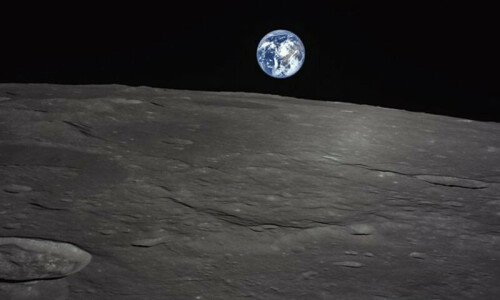
ISLAMABAD: Japanese space startup ispace is set to attempt a challenging lunar landing on June 6, 2025, with its unmanned lander named Resilience.
This marks the company’s second try after its first mission in 2023 ended with a crash landing on the moon’s surface.
If successful, ispace will become the third private entity ever to complete a moon landing and the first company outside the United States to do so.
The landing attempt is scheduled for early Friday morning Japan time and will be live-streamed on ispace’s website, reflecting growing private-sector ambitions in space exploration.
Building on Past Experience for Success
Ispace CEO Takeshi Hakamada expressed confidence in the upcoming mission, highlighting lessons learned from their initial attempt and the current voyage. Only five countries — the Soviet Union, the United States, China, India, and Japan — have managed soft landings on the moon so far.
Private companies are increasingly competing to provide cost-effective and frequent space missions, challenging government dominance. Last year, Intuitive Machines became the first private company to land on the moon, albeit with some landing angle issues.
More recently, Firefly Aerospace’s Blue Ghost achieved a successful touchdown on the same SpaceX rocket launch as Resilience.
Challenges and Competition in Lunar Exploration
Lunar landings require precise control of thrusters to slow spacecraft descent, making the task extremely difficult. While Intuitive Machines’ follow-up mission recently failed, ispace is hopeful for a successful landing despite Resilience’s longer travel time to the moon.
Meanwhile, another Japanese startup, Space One, is also pushing private space boundaries by attempting satellite launches, though it faced setbacks in a recent rocket launch. The upcoming landing by Resilience is a significant milestone that could boost Japan’s position in private space exploration.