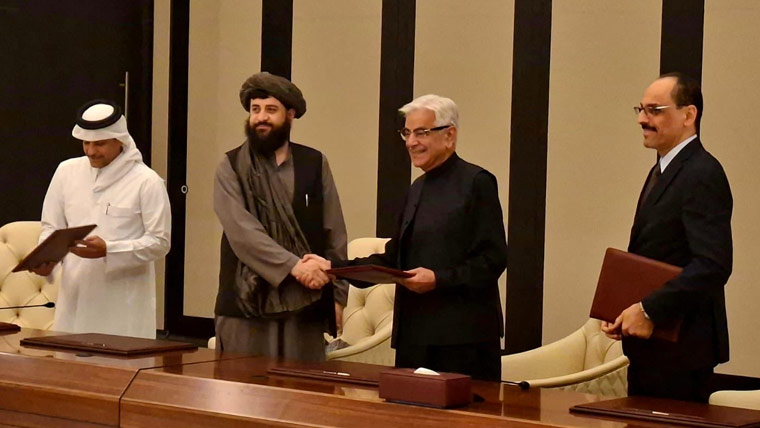
Doha : A ceasefire agreement has been successfully reached between Pakistan and Afghanistan after marathon negotiations held in Doha, Qatar.
Pakistan’s Defence Minister, Khawaja Asif, confirmed the agreement, stating that both countries have pledged to respect each other’s borders. He further assured that terrorism originating from Afghan soil will immediately cease its activities on Pakistani territory.
The talks, which were facilitated by Qatar and Turkey, saw Khawaja Asif leading the Pakistani delegation, while Afghan Defence Minister Mullah Mohammad Yaqoob represented Afghanistan. The negotiations stretched for nearly 13 hours, during which both sides agreed on a ceasefire and committed to holding further discussions in the future.
The Qatari Ministry of Foreign Affairs emphasized that the ceasefire agreement marks a significant step towards establishing lasting peace in the region, with an aim to ease growing border tensions between the two countries.
Khawaja Asif confirmed the deal on X (formerly Twitter), thanking Qatar and Turkey for their role in facilitating the talks. He also announced that a follow-up meeting will take place in Istanbul on October 25, where further details of the agreement will be discussed.
Experts believe that this agreement may prove disappointing for India, as it would likely disrupt Afghan-based efforts supported by India to destabilize Pakistan.
The first round of discussions was hosted by Qatari Intelligence Chief Abdullah bin Mohammed al-Khalifa. Pakistan’s security officials supported Defence Minister Khawaja Asif, while the Afghan delegation, led by Mullah Mohammad Yaqoob, included key Afghan intelligence figures.