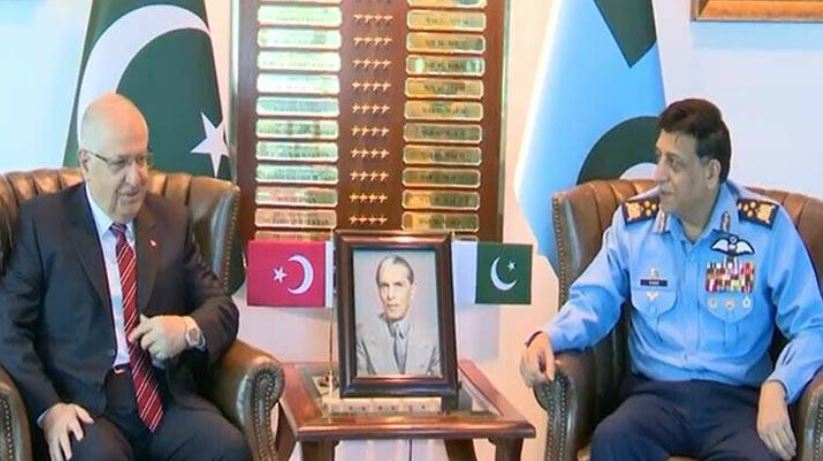
Islamabad :A high-level delegation led by Turkey’s Defense Minister Yaşar Güler visited Islamabad’s Air Headquarters for strategic talks with Pakistan Air Force Chief Air Chief Marshal Zaheer Ahmad Baber Sidhu. The meeting centered on regional security challenges, defense cooperation, and future joint initiatives.
Air Chief Marshal Sidhu underscored the enduring brotherhood between Pakistan and Turkey, reaffirming the Pakistan Air Force’s resolve to advance cooperation in defense, training programs, and aerospace technology.
Both parties agreed to establish joint working groups to streamline and advance cooperation in key focus areas.
Thanking the Pakistan Air Force for their hospitality, Minister Güler praised their professionalism and unwavering dedication during the recent Pakistan-India tensions, lauding the leadership of Air Chief Marshal Sidhu.
Güler highlighted potential collaboration in avionics, modern unconventional warfare tech, and unmanned aerial systems (UAS). He also acknowledged Pakistan’s continuous support for the pilot exchange program, viewing it as crucial for fostering operational synergy between the two air forces.
The leaders concurred on expanding training exchanges and increasing the scope of bilateral and multilateral air exercises.
This visit marks a significant milestone in deepening the growing defense partnership, strategic coordination, and institutional military ties between Pakistan and Turkey.