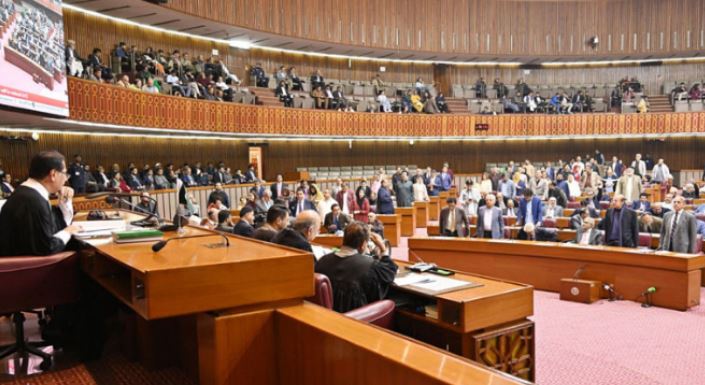
Islamabad : In a historic move, the National Assembly of Pakistan on Wednesday passed the 27th Constitutional Amendment Bill with a decisive two-thirds majority, marking a significant step towards overhauling the country’s judicial and military systems. This comes just days after the Senate gave its backing to the crucial legislation.
The amendment bill, which introduces sweeping reforms, incorporates eight new changes, replacing four previous clauses and adding four fresh provisions. A key aspect of the bill is the introduction of the term “Federal Constitutional Court” in Clause 2 of Article 6. Additionally, Article 10 has been amended to include the term “Supreme Court,” and Article 176 now clarifies that the Chief Justice of Pakistan will retain their title until the completion of their term.
Following its passage in the lower house, the bill will be sent back to the Senate for a review of the new amendments before it is officially ratified. Prime Minister Shehbaz Sharif and PML-N leader Nawaz Sharif were both present for the session, which is seen as a turning point in Pakistan’s constitutional evolution.
Law Minister Azam Nazeer Tarar, who tabled the bill after a two-day debate, highlighted that the essence of the reforms had already been shared with the Senate. He described constitutional amendments as an ongoing, evolutionary process and assured that all stakeholders were consulted in the drafting of the bill.
Tarar also confirmed that Justice Yahya Afridi would continue as Chief Justice of Pakistan and emphasized that the power to amend the Constitution lies solely with the Parliament, not the judiciary.
The bill, requiring a two-thirds majority from the 336-member National Assembly, passed easily due to the strong backing from the ruling coalition. The PML-N, which holds 125 seats, was joined by the PPP (74 seats), MQM-P (22 seats), PML-Q, and Istehkam-e-Pakistan Party (4 seats each), alongside one seat each from PML-Z, BAP, and the National Peoples Party.
With 59 clauses, the amendment bill aims to restructure key judicial and military institutions. In the Senate, the amendment was passed with 64 votes in favor out of 96, though opposition parties boycotted the sitting and staged protests by tearing up copies of the bill. Despite the opposition’s resistance, several senators, including those from ANP, PTI-backed Saifullah Abro, and JUI-F’s Ahmed Khan, lent their support to the bill, though Abro later resigned from the Senate.
During the session, Speaker Sardar Ayaz Sadiq invited Pakhtunkhwa Milli Awami Party leader Mahmood Khan Achakzai to address the House. Achakzai harshly criticized the government, calling it a “Form-47 setup,” and questioned whether a parliament formed through disputed elections had the moral authority to amend the Constitution. In a dramatic gesture, Achakzai tore his copy of the bill in protest.
Amid the heated debate, Speaker Ayaz Sadiq called for dialogue between the government and opposition, offering his mediation. He reiterated that Prime Minister Shehbaz Sharif had consistently invited the opposition for talks, and PTI Chairman Barrister Gohar Ali Khan responded by reaffirming his party’s willingness to engage in dialogue.
Speaking to reporters after the vote, Law Minister Azam Tarar emphasized that the Senate would have the opportunity to make further adjustments during its review. He called for transparency in addressing any ambiguities in the proposed changes.
Information Minister Attaullah Tarar also criticized the opposition for rejecting the bill, accusing them of “double standards” and “selective morality.” He reminded opposition lawmakers of their embrace of authoritarianism when in power, claiming they now resist legitimate parliamentary reforms.
The elevation of the Chief of Army Staff to the rank of Chief of Defence Forces, with lifelong honorary titles such as Field Marshal, Marshal of the Air Force, and Admiral of the Fleet. The establishment of a Federal Constitutional Court with equal representation from all provinces, which will have the power to take suo motu notice on petitions. The Islamabad High Court will also have one judge on the Federal Constitutional Court’s bench. A new process for the appointment of judges, with both the President and Prime Minister playing a central role in selecting judges for the Federal Constitutional Court. Some powers of the Supreme Court will be delegated to the newly formed Federal Constitutional Court. Presidential immunity will be revoked if the president assumes a public office after completing their term. Judges must have at least five years of service in a high court to be eligible for the Federal Constitutional Court. The Judicial Commission will oversee the transfer of high court judges, while the Supreme Judicial Council will handle objections related to these transfers. The amendment grants the President lifetime immunity from criminal proceedings, and governors will enjoy the same protection during their tenure. However, this immunity will not apply once they leave office.