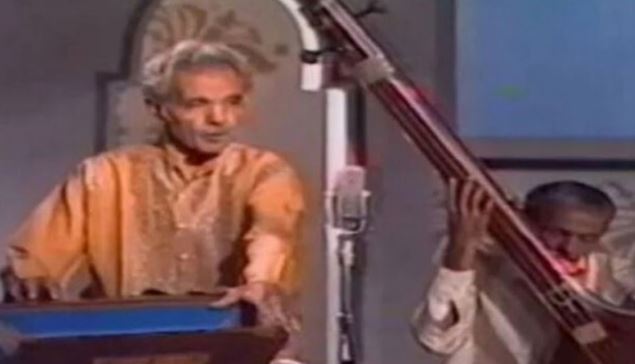
Lahore : The 39th death anniversary of the legendary classical vocalist Ustad Chhote Ghulam Ali Khan was observed on Monday, with admirers and members of the music community reflecting on his remarkable contributions to classical music in South Asia.
Born in 1910 in Kasur, Ustad Chhote Ghulam Ali Khan hailed from a family with deep musical roots. He was introduced to music early on, learning under the guidance of his father, Mian Imam Bakhsh, a distinguished singer known for his unique style. Recognizing his talent, he later trained under the mentorship of legendary figures like Ustad Chhajju Khan and Ustad Mian Buddhay Khan Beenkar, the latter being a disciple of the renowned Delhi-based Qawwal Bacha tradition.
Ustad Chhote Ghulam Ali Khan’s versatility set him apart, as he excelled in a wide array of classical music genres including khayal, tarana, thumri, dadra, and ghazal. His powerful voice and performances captivated audiences across undivided India, with his presence felt in cultural centers such as Lahore, Amritsar, Delhi, Banaras, Calcutta, and Bombay.
From the early days of radio broadcasting in the Subcontinent, he became a frequent and celebrated figure on airwaves, widely regarded as one of the finest performers of his generation. His influence grew over the years, and he became a key figure in major music events and concerts.
Beyond his performances, Ustad Chhote Ghulam Ali Khan played a crucial role in mentoring the next generation of singers. He worked closely with the Lahore Arts Council, where he trained and shaped the careers of many up-and-coming artists, including Shahida Parveen, Badr-uz-Zaman, and Qamar-uz-Zaman.
In 1985, his remarkable contributions to the world of classical music were formally recognized when he was awarded the Presidential Pride of Performance Award by the Government of Pakistan.
Ustad Chhote Ghulam Ali Khan passed away on December 24, 1986, leaving behind a musical legacy that continues to influence both contemporary and classical music communities. He was laid to rest in Miani Sahib graveyard in Lahore, where his memory endures, and his contributions are celebrated by music lovers and artists alike.