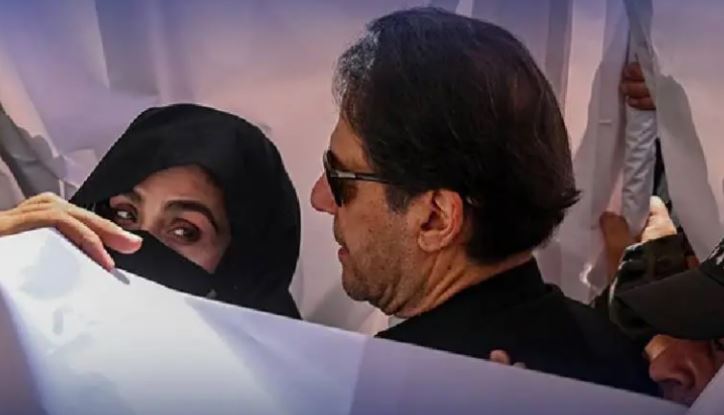
Islamabad : A recent report by the British magazine The Economist sheds light on the considerable influence Bushra Bibi, the wife of former Prime Minister Imran Khan and founder of Pakistan Tehreek-e-Insaf (PTI), held over political decisions and the daily functioning of his government.
The article suggests that Bushra Bibi’s arrival in Imran Khan’s life coincided with the introduction of several unconventional practices at his residence. Former staff members have revealed that certain rituals, such as rotating raw meat over Imran Khan’s head, burning red chilies, and discarding the heads of black goats or chickens in a graveyard, became regular occurrences. A butcher interviewed for the report confirmed that live black goats were sometimes ordered specifically for these rituals.
Bushra Bibi’s influence became widely discussed after Imran Khan assumed office in 2018. Sources close to the government revealed that she was involved in shaping crucial appointments, influencing daily administrative decisions, and even advising on the prime minister’s travel plans, both within Pakistan and abroad.
The report claims that Bushra Bibi’s spiritual advice often overshadowed institutional guidance, a factor that some insiders believe contributed to Khan’s struggles in implementing significant reforms. Additionally, the article notes that criticism of Bushra Bibi within PTI was discouraged, and party members who opposed her would often face consequences, including being marginalized.
One specific example mentioned in the report is the dismissal of Aun Chaudhry, who was reportedly removed from his position after falling out of favor with Bushra Bibi. Staff members claimed that Imran Khan frequently sought her opinion before making any significant political or administrative decisions.
The Economist also touches on the fact that Pakistan’s intelligence agencies began monitoring Bushra Bibi after her secret marriage to Imran Khan. Officials allegedly provided her with selective information through intermediaries, which she then shared with Khan as spiritual revelations, further cementing his trust in her influence.
As her role in the government grew, it reportedly led to strained relations between Imran Khan and the military leadership, particularly with then-Army Chief General Qamar Javed Bajwa. Senior officials in the government believed that Bushra Bibi’s advice played a key role in the removal of ISI Director-General Lt Gen Asim Munir in 2019.
Following Imran Khan’s removal from office in 2022, both he and Bushra Bibi became embroiled in multiple legal cases and are currently in custody. Despite the controversies surrounding her influence, some within PTI still hope that Bushra Bibi may help repair the relationship between Khan and the military, although senior figures like Khan’s sister Aleema are said to be opposed to any such reconciliation.
The Economist concludes that Bushra Bibi’s behind-the-scenes influence was a central feature of Imran Khan’s time in power. The report also revisits the early days of their relationship, which began through her sister, Maryam. Initially, Bushra Bibi was hesitant to meet with unrelated men, but over time, their interactions grew from lengthy phone conversations to private meetings, eventually leading to their marriage and her significant influence over his political decisions.